---
title: Why “quick” one-liners can turn into expensive compliance problems
description: One-liners feel fast, but copy-paste shortcuts can quietly repeat errors. Learn where compliance risk builds, and how a controlled flow reduces fines.
image: https://www.customaite.ai/hubfs/white-paper-stack-in-folder-file-for-a-business-2024-12-02-03-20-18-utc.jpg
---
[](https://www.customaite.ai/home)
[](https://www.customaite.ai/home)
- [Solutions](https://www.customaite.ai/features)
- By suite
- [Compliance](https://www.customaite.ai/customs-compliance-suite)
- [Automation](https://www.customaite.ai/solutions/automation)
- [Workflow](https://www.customaite.ai/solutions/workflow)
- By area
- [IT](https://www.customaite.ai/solutions/it)
- [Customs Manager](https://www.customaite.ai/solutions/customs-manager)
- [CFO](https://www.customaite.ai/solutions/cfo)
- By business
- [Customs brokers](https://www.customaite.ai/solutions/customs-brokers)
- [Freight forwarders](https://www.customaite.ai/solutions/freight-forwarders)
- [Plans](https://www.customaite.ai/plans)
- Resources
- [Blogs](https://www.customaite.ai/blog)
- [Testimonials](https://www.customaite.ai/testimonials)
- [Documentation](https://www.customaite.ai/documentation)
- [RFP Template](https://www.customaite.ai/rfp-template)
- [FAQs](https://www.customaite.ai/faqs)
- [Glossary](https://www.customaite.ai/glossary)
- [Security](https://www.customaite.ai/security)
- [Careers](https://www.customaite.ai/jobs)
- [About us](https://www.customaite.ai/about-us)
More results
[Talk to us](https://www.customaite.ai/talk-to-us) [Request demo](https://www.customaite.ai/demo-request)
[Talk to us](https://www.customaite.ai/talk-to-us) [Request demo](https://www.customaite.ai/demo-request)
- [About us](https://www.customaite.ai/about-us)
- [Solutions](https://www.customaite.ai/features)
- By suite
- [Compliance](https://www.customaite.ai/customs-compliance-suite)
- [Automation](https://www.customaite.ai/solutions/automation)
- [Workflow](https://www.customaite.ai/solutions/workflow)
- By area
- [IT](https://www.customaite.ai/solutions/it)
- [Customs Manager](https://www.customaite.ai/solutions/customs-manager)
- [CFO](https://www.customaite.ai/solutions/cfo)
- By business
- [Customs brokers](https://www.customaite.ai/solutions/customs-brokers)
- [Freight forwarders](https://www.customaite.ai/solutions/freight-forwarders)
- [Plans](https://www.customaite.ai/plans)
- Resources
- [Blogs](https://www.customaite.ai/blog)
- [Testimonials](https://www.customaite.ai/testimonials)
- [Documentation](https://www.customaite.ai/documentation)
- [RFP template](https://www.customaite.ai/rfp-template)
- [FAQs](https://www.customaite.ai/faqs)
- [Security](https://www.customaite.ai/security)
- [Jobs](https://www.customaite.ai/jobs)
[Request demo](https://www.customaite.ai/demo-request)
Get in touch: [+32 495 563 769](tel:+32495563769)
[Expert story](https://www.customaite.ai/blog/tag/expert-story)
# Why “quick” one-liners can turn into expensive compliance problems
[](https://www.customaite.ai/blog/author/mieke-beelen)
by [Mieke Beelen](https://www.customaite.ai/blog/author/mieke-beelen)
3 min read
Dec 10, 2025
### Why “quick” one-liners can turn into expensive compliance problems
Last week we looked at one-liners through a performance lens, which you can read [here](https://www.customaite.ai/blog/the-quick-one-liners-that-quietly-mess-up-your-team-metrics). This week we are looking at another aspect of declaring one-liners, one that gives customs managers a reason to worry, compliance.
**Two parts of the filing process, two very different roles**
Customs declarations get legally filed in traditional declaration software. They handle the formal steps, messaging to customs, procedure management, and compliance administration.
Customaite comes before that. It is where work is automated and made measurable. It takes unstructured documents, such as invoices, packing lists, and transport documents, extracts data, proposes a complete declaration dataset, and provides the declarant with safeguards to make sure the declaration is compliant. As a bonus on top, every declaration is measured, and you get a full performance overview of your workforce.
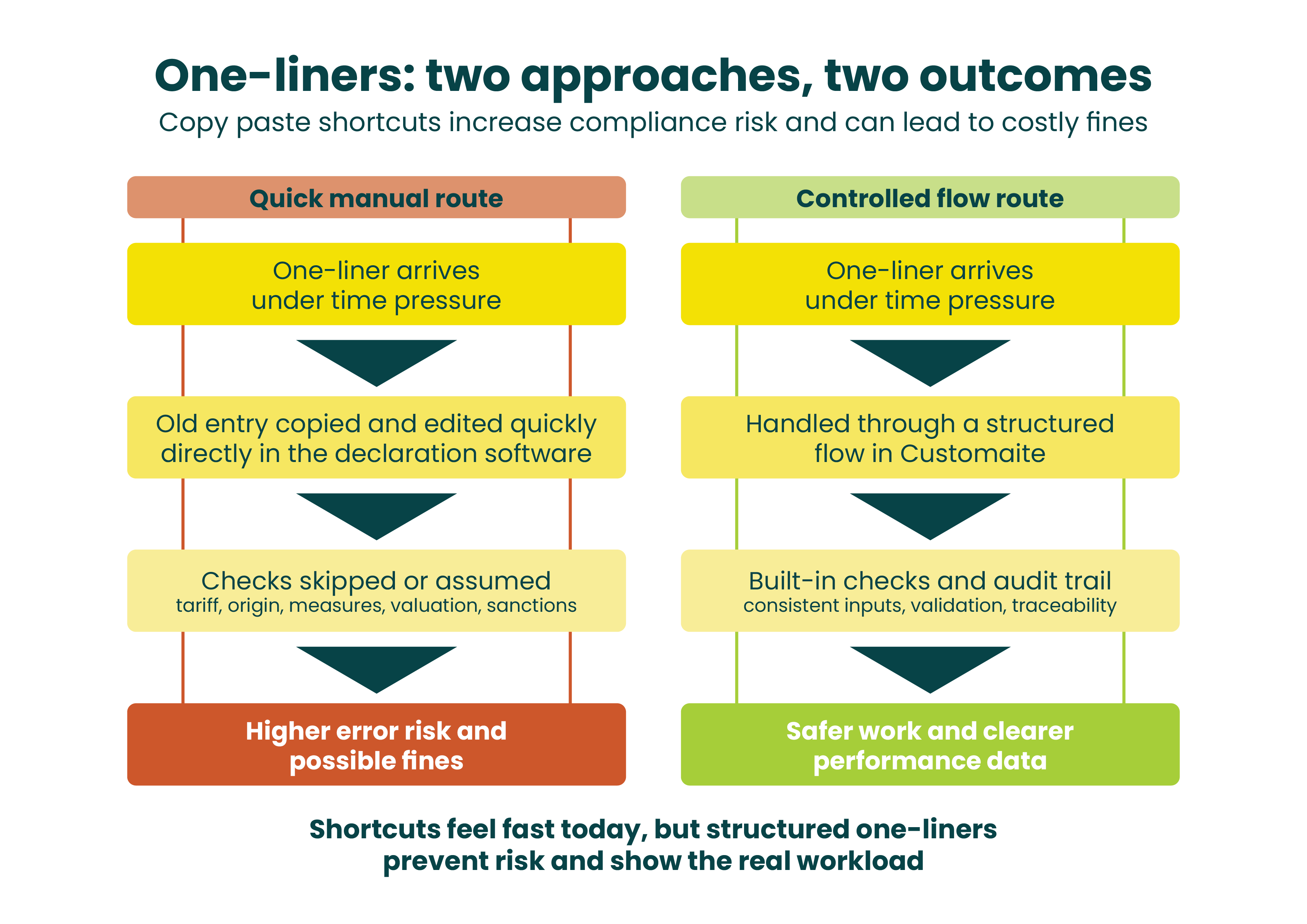
When a one-liner is entered directly in the declaration software and Customaite is bypassed, the filing still happens, but it skips the structured prep stage and the built-in compliance safeguards. That’s when things start to go wrong.
**How corners get cut**
Every declarant’s team knows the moment. A lorry is waiting. A forwarder is on the phone. A customer asks, “Can you just correct the value?” or “Same as last time, can you push it through?” The case looks tiny, so someone copies a previous entry, tweaks a couple of fields, and submits.
Fast, yes. Safe, not always.
**Why one-liners trigger copy-paste risk**
One-liners feel familiar: same customer, same goods, same route. That is exactly why people copy and paste. The trouble is that customs rules and shipment details change quietly.
If the copied entry contains a mistake, you do not just repeat it once, you carry it forward. A wrong tariff code, an outdated origin, an incorrect preference claim, an old valuation setup: copy-paste turns a single error into a pattern.
**The mistakes teams are facing right now**
These are the “it was the same as last time” risks managers across Europe see regularly:
- **Origin or preference shifts** because the supplier or production site changed, but the old origin was copied over.
- **Tariff code drift** when the goods changed slightly, but the same code got reused out of habit.
- **New measures on old commodities** such as anti-dumping or safeguards, where last month’s entry is no longer valid.
- **Sanctions or restricted-party checks** skipped because “we have shipped to them before”.
- **Valuation changes** (credit notes, Incoterms, surcharges) are missed because the old structure was pasted in.
- **Simple typing leftovers** like weights, invoice numbers, or preference indicators that were never meant to stay.
**Why bypassing a controlled flow makes this worse**
Even when one-liners are processed directly in the declaration software, the risk still goes up if they skip the preparation flow. Most declaration systems do have built-in checks and validations, but these mainly confirm that the entry is complete and consistent within the system itself.
Customaite adds a different layer of control. It validates the data against the original source documents, such as invoices, packing lists, transport documents, and certificates. In other words, it does not only check whether the declaration “looks right” in the software, but whether it matches what the paperwork actually says and what applies today. When a one-liner bypasses that step, you lose that document-level validation and traceability, and that is where copy-paste errors are most likely to slip through and get repeated.
A controlled flow:
1. Standardises inputs, so declarants do not rely on memory or old entries.
2. Runs the right checks automatically, tariff logic, origin rules, measure updates, license prompts, valuation and sanity checks.
3. Leaves a traceable record of decisions for audits.
Without that layer, one-liners rely on speed and habit and that is where corners get cut.
**Small error, big consequence**
Fines and recoveries are about correctness, not effort. A wrong tariff code can mean duty recovery plus penalties across multiple entries. A preference error can trigger back duties and push an importer into a higher-risk bracket. A sanction miss can become a serious legal issue.
The one-liner is quick. The consequences are not.
**What changes when one-liners follow a structured process**
When one-liners go through the same structured process as everything else, speed and compliance stop competing. Declarants stay fast because they are supported by automation and consistent checks. Managers get reliable quality and a clear audit trail.
And logging everything in one place gives you a complete, honest view of the real day, including the small cases that shape workload and customer effort.
**The takeaway**
Copy-pasting one-liners feels efficient, but it is how errors get repeated and risk builds quietly over time. A controlled flow protects accuracy, reduces fines, and gives you a trustworthy picture of your team’s work.
If you want to explore what a structured one-liner process could look like in your setup, click here to speak with one of our experts.
[](https://www.customaite.ai/hs/cta/wi/redirect?encryptedPayload=AVxigLJwWyOW62RJhhqktY7esXyu81qNuZdKu2%2BpBTwbDsJ6WXBwXZx3lT6t4%2BYRtjB4pBJFdbS2eTZPNDDRzwPR8K3SlUw12AhvhWG0ahUFzV9gbezIyN%2Ft2ElAFGGP5pgOwI%2FFbpvKH9HjnyWZGgXdLZDyzTpJdY%2Fq42jDnQfs3OB7A6Ck5hsxVsvPPSV%2BgiV3%2BZj6cnbq4MNnVrd5WN7H&webInteractiveContentId=295799164108&portalId=144183569)
Share this
[Share on X](https://x.com/intent/post?url=https://www.customaite.ai/blog/why-quick-one-liners-can-turn-into-expensive-compliance-problems&text=Why+%26ldquo%3Bquick%26rdquo%3B+one-liners+can+turn+into+expensive+compliance+problems) [Share on Facebook](https://www.facebook.com/sharer/sharer.php?u=https://www.customaite.ai/blog/why-quick-one-liners-can-turn-into-expensive-compliance-problems&t=Why+%26ldquo%3Bquick%26rdquo%3B+one-liners+can+turn+into+expensive+compliance+problems) [Share on LinkedIn](https://www.linkedin.com/shareArticle?mini=true&url=https://www.customaite.ai/blog/why-quick-one-liners-can-turn-into-expensive-compliance-problems&t=Why+%26ldquo%3Bquick%26rdquo%3B+one-liners+can+turn+into+expensive+compliance+problems)
Previous story
[← The “quick” one-liners that quietly mess up your team metrics](https://www.customaite.ai/blog/the-quick-one-liners-that-quietly-mess-up-your-team-metrics)
Next story
[From extraction to enrichment: a new milestone for Customaite →](https://www.customaite.ai/blog/from-extraction-to-enrichment-a-new-milestone-for-customaite)
## You May Also Like
These Related Stories
[How better customer communication speeds up customs clearance](https://www.customaite.ai/blog/how-better-customer-communication-speeds-up-customs-clearance)

[Expert story](https://www.customaite.ai/blog/tag/expert-story)
### How better customer communication speeds up customs clearance
Sep 07, 2026 4 min read
[What HMRC’s new AI guidance means for customs professionals](https://www.customaite.ai/blog/what-hmrcs-new-ai-guidance-means-for-customs-professionals)

[Expert story](https://www.customaite.ai/blog/tag/expert-story)
### What HMRC’s new AI guidance means for customs professionals
Feb 12, 2026 3 min read
[Why customs teams need a single source of truth](https://www.customaite.ai/blog/why-customs-teams-need-a-single-source-of-truth)

[Expert story](https://www.customaite.ai/blog/tag/expert-story)
### Why customs teams need a single source of truth
Aug 03, 2026 5 min read
### No Comments Yet
Let us know what you think
#### About Customaite
The trusted AI platform for customs automation, delivering speed, accuracy and compliance.
[](https://www.customaite.ai/security)
[](https://www.customaite.ai/security)
[](https://www.womeninlogistics.co.uk/) [](https://www.women-in-logistics.eu/)
[Follow us on Instagram](https://www.instagram.com/customaite/)[Follow us on Facebook](https://www.facebook.com/Customaite)[Follow us on LinkedIn](https://www.linkedin.com/company/customaite)[Watch us on Vimeo](https://vimeo.com/customaite)[Watch us on YouTube](https://www.youtube.com/@Customaite)
[Features](https://www.customaite.ai/features)
- [Our features](https://www.customaite.ai/features)
- [How does Customaite work](https://www.customaite.ai/how-customaite-works)
- [Our latest product updates](https://www.customaite.ai/customaite-latest-product-updates)
[Plans](https://www.customaite.ai/plans)
- [Customaite Lite](https://www.customaite.ai/plans)
- [Customaite Pro](https://www.customaite.ai/plans)
- [Customaite Enterprise](https://www.customaite.ai/plans)
Resources
- [Read our blog](https://www.customaite.ai/blog)
- [Testimonials](https://www.customaite.ai/testimonials)
- [Documentation](https://www.customaite.ai/documentation)
- [FAQs](https://www.customaite.ai/faqs)
- [Newsletter](https://www.customaite.ai/newsletter)
- [Glossary](https://www.customaite.ai/glossary)
Company
- [About us](https://www.customaite.ai/about-us)
- [Join our team](https://www.customaite.ai/jobs)
- [Events](https://www.customaite.ai/events)
- [Contact us](https://www.customaite.ai/contact)
- [AI info](https://www.customaite.ai/ai-info-page)
- [Sitemap](https://www.customaite.ai/sitemap)
Guides
- [AI for customs compliance](https://www.customaite.ai/ai-for-customs-compliance/guide)
Copyright © 2026 Customaite.
[Privacy](https://www.customaite.ai/privacy-policy)
```json
{
"@context" : "https://schema.org",
"@type" : "BlogPosting",
"author" : {
"@type" : "Person",
"name" : "Mieke Beelen",
"url" : "https://www.customaite.ai/blog/author/mieke-beelen"
},
"dateModified" : "2025-12-10T13:28:41.856Z",
"datePublished" : "2025-12-10T13:19:33.000Z",
"headline" : "Why “quick” one-liners can turn into expensive compliance problems",
"image" : [ "https://www.customaite.ai/hubfs/white-paper-stack-in-folder-file-for-a-business-2024-12-02-03-20-18-utc.jpg" ],
"mainEntityOfPage" : {
"@id" : "https://www.customaite.ai/blog/why-quick-one-liners-can-turn-into-expensive-compliance-problems",
"@type" : "WebPage"
},
"publisher" : {
"@type" : "Organization",
"logo" : {
"@type" : "ImageObject",
"url" : "https://www.customaite.ai/hubfs/Customaite%20logos%20and%20favicons/Customaite_volledig_Geel_Groen.png"
},
"name" : "Customaite"
}
}
```