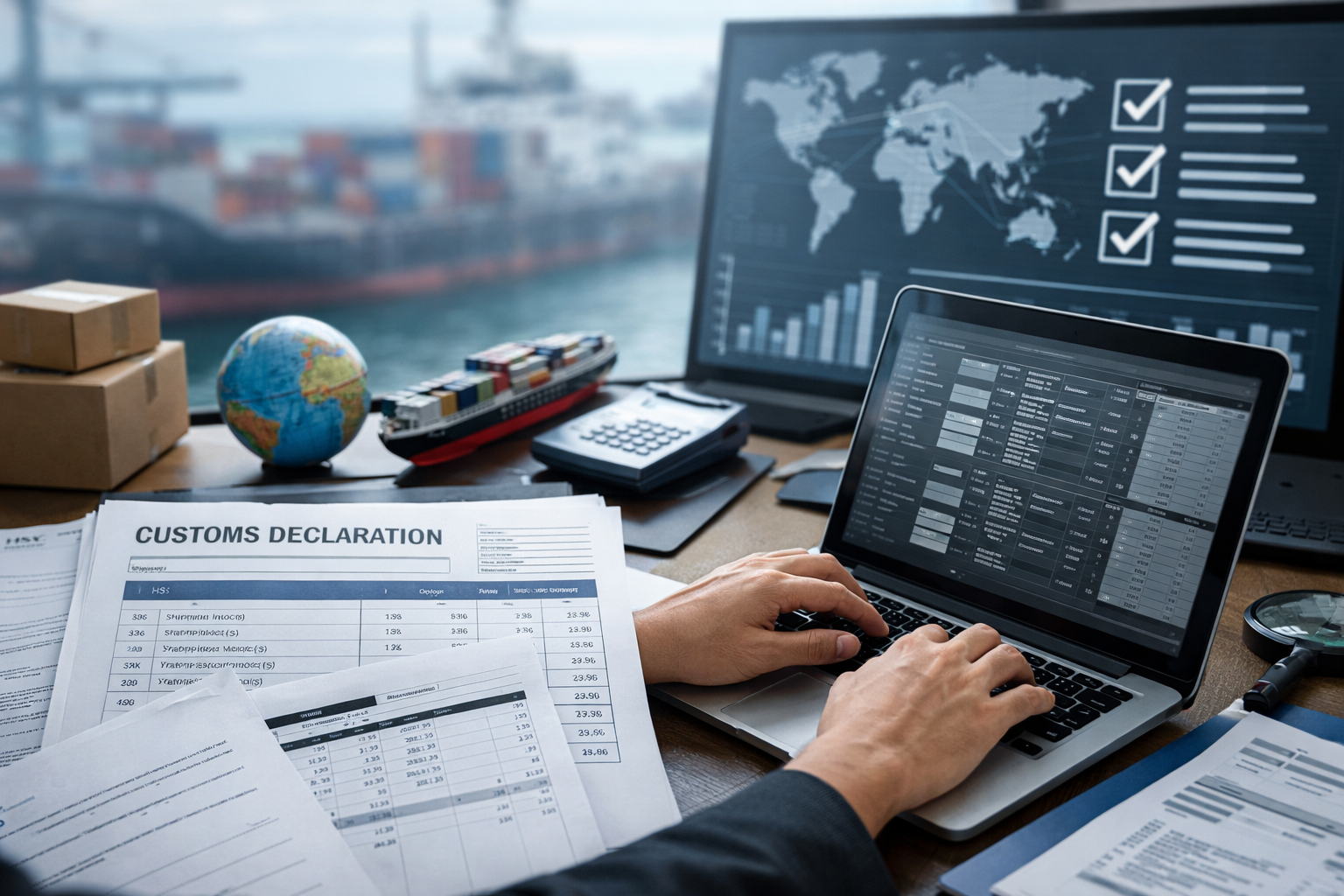
Ask a customs declarant what they were trained to do, and you'll hear about classification, valuation, duty calculation, and compliance. Ask them what actually fills their day, and you'll get a different answer: emails. Phone calls. Follow-ups. Chasing down the one missing invoice line or the document that never arrived. Somewhere between the job they trained for and the job they actually do, customs declarant information gathering has quietly become the main event, and declaring goods has become the thing squeezed in around it.
Compliance is no longer optional
In international trade, customs compliance is not a nice-to-have. And in today's environment, with geopolitical tension rising and the effects of climate change increasingly visible, the rules of trade are changing faster than ever. Executing trade compliantly against that moving backdrop is not optional. It is what stands between a shipment and costly delays or significant fines.
Yet most of trade compliance still runs on unstructured documents. Our technology is advancing quickly and AI is everywhere, but the companies in a logistics chain are, for the most part, still exchanging information by email with documents attached. In the best case that document is an Excel file. Far more often it is a PDF, and more often than not, a scanned one.
How the process works today
Picture an importer who wants to buy goods from outside the EU and has struck a deal with a supplier. Once the deal is closed and the goods are ready to ship, the workflow tends to look like this:
- The importer either runs the process themselves or appoints a freight forwarder to handle it.
- An export declaration is required to get the goods out of the country of origin, usually handled by the exporter or supplier on that side. (That is a topic in its own right, so for now let's assume it happens.)
- The goods are shipped, and the full documentation set is sent to the importer.
- Once the goods arrive, the importer either files the import declaration themselves or hires a customs broker to do it.
- Over to the customs declarant. In many cases, documents are missing, or the tariff codes, origin, customs value or required licences are incomplete or invalid for the European Union.
- What follows is a race against time. The declaration has to be submitted and validated on schedule, and the information has to be right. The declarant has two options: use what is available and hope for the best, at the risk of delays and heavy fines, or chase down the correct information and documentation.
- That chase usually means a stream of back-and-forth emails and phone calls, repeatedly checking whether an answer has come in and whether it is correct. It is enormously time-consuming, and still error-prone, because the clock is always running.
What changes when compliance moves to the start
So what would this look like if we could move compliance to the start of the process?
Imagine that, at the moment the documentation for the customs declaration is handed over, the person who actually knows the transaction is guided through it and asked, then and there, to supply the missing documents or answer the open questions. Imagine that this is no more effort than sending an email, and far less effort than untangling the same problem later, under time pressure.
That is exactly Customaite's vision: bring the compliance intelligence layer to the start of the process, and do it in a way that measurably improves the experience for everyone involved in the transaction.
Why shortcuts won't hold
Some customs brokers are leaning the other way. They ask their customers to do the hard part, manually copying and structuring the data into a web platform (or Excel template) before the order is submitted for the declaration. Once the data is structured, validating compliance does get a little easier.
At Customaite, we are convinced those companies will not last. Given the technology available today, and rising customer expectations for both quality and speed, there is far more on the table. That does not make the solution easy to build. Anyone who believes that some clever prompting of an advanced LLM, ChatGPT, Claude, Kimi and the like, will do the job will soon discover that a truly successful solution takes considerably more than that.
Built on customs expertise, accelerated by AI
We are proud to have built a front-runner solution that served local and global companies before LLMs were even part of the conversation. Today we are extending that lead by adding new (agentic) AI where it matters most, while still relying on the deep customs expertise built into our engines. Our original vision of a human in the loop at every single step is shifting toward autonomous systems, with the guardrails set and maintained by customs compliance experts.
The point of this article holds either way: garbage in means heavy effort to fix it later in the process. By catching potential compliance issues at the very start, we are adding efficiency across the entire process, not just at the moment of filing. We are no longer improving the work of the declarant alone. We are delivering time savings and stronger operational performance across the full trade transaction.
Move compliance to where it belongs: the start
If your team is still clarifying missing documents, tariff codes and origin details under deadline pressure, there is a better way to work. See how Customaite brings the compliance intelligence layer to the start of every transaction. Get in touch for a demo.



No Comments Yet
Let us know what you think