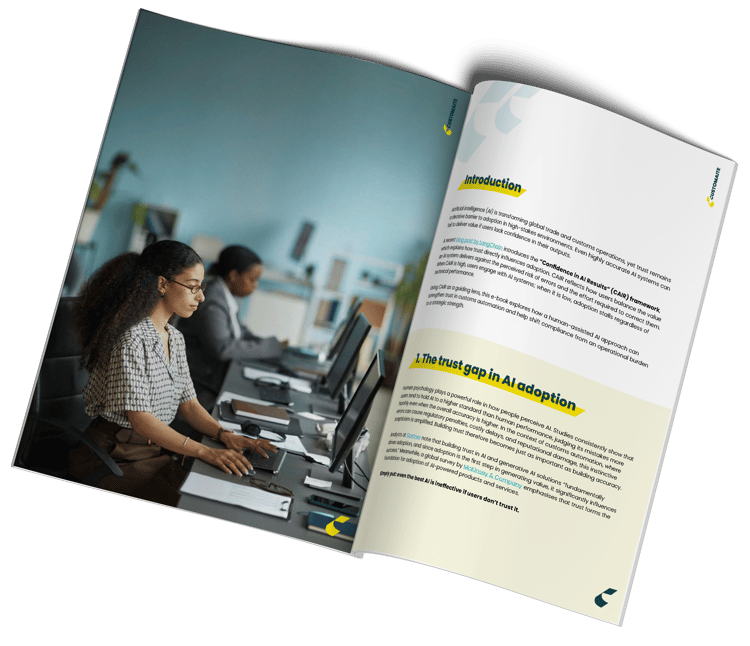
The confidence factor: Why trust defines the future of customs automation
Artificial intelligence is reshaping global trade and customs operations, but trust remains a critical barrier to adoption. Even the most accurate AI systems fall short if users lack confidence in their results.
Drawing on the “Confidence in AI Results” (CAIR) framework introduced by LangChain, this e-book explores how trust, perceived risk and human oversight determine whether AI delivers real value. Using CAIR as a guiding lens, it shows how a human-assisted AI approach can strengthen confidence in customs automation and transform compliance from an operational burden into a strategic advantage.
Why trust defines the future of customs automation
AI is transforming customs and global trade, but adoption often stalls because users do not fully trust AI outcomes in high-stakes environments.
The e-book introduces the Confidence in AI Results (CAIR) framework, which explains how trust determines whether AI systems are actually used.
CAIR shows that adoption depends on the balance between value delivered, risk of errors, and the effort required to correct mistakes.
In customs operations, trust matters more than raw accuracy, because errors can lead to delays, fines and reputational damage.
A human-assisted AI approach increases confidence by keeping professionals in control, allowing them to review, correct and understand AI suggestions.
When AI is transparent, reversible and designed around human oversight, compliance shifts from an operational burden to a strategic advantage.
Download our eBook