Pillar Page

AI for customs compliance


What is AI for customs compliance?

AI for customs compliance uses machine learning to read trade documents, extract and enrich declaration data, suggest classifications, and validate the result against customs rules before submission. It speeds up the work and catches errors earlier. It does not replace the declarant, who stays responsible for the customs declaration.


What does AI for customs compliance do?

It takes over the document-heavy steps of a customs declaration: reading documents, extracting and enriching data, suggesting HS codes, validating the result and preparing the filing. A human in the loop reviews what is flagged, and the declarant stays responsible for the declaration.


How does AI read customs documents?

AI reads invoices, packing lists, transport documents and emails and turns them into declaration data. This is customs document automation: the system reads the supporting documents, applies customs data extraction and enriches the result with product and tariff information. A person checks what it flags.


Can AI classify HS codes?

Automated HS code classification can suggest HS codes, but the result depends on the context: product descriptions, tariff data and legal text. Without that context, a model can state a wrong code with confidence. Suggested codes still go to a declarant for review.


What changes for the declarant?

The job shifts from typing to reviewing. Customs declarants spend their time on exceptions and decisions instead of retyping lines.


How is customs AI different from ChatGPT?

A general chatbot can explain customs, but it can state a wrong HS code with full confidence and keeps no audit trail. Purpose-built customs AI is grounded in tariff data, validates its output and records every step.


How does it fit with your existing software?

Customaite works alongside the declaration software you already use, including Stream, Descartes and ASM Sequoia, through a customs software integration, so your filing process stays the same.


How does AI keep a declaration compliant?

By checking before submission, not after. Validation, confidence flags, human review and an audit trail are built into the workflow. This is the idea behind compliance by design.

.


What do you need to get good results?

Clear supporting documents, accurate product descriptions and good customs data quality.


Who's it for?

Customs brokers, freight forwarders, enterprise trade compliance teams, finance leaders and IT teams who run connected customs workflows.

Explore the topic

AI in customs: what it does and its limits

Document processing

HS code classification

Validation before submission

Intake and missing information

Data consistency

Customer proof

Move faster. Stay compliant. Trade confidently

Thirty minutes. We'll show you what Customaite looks like running on your own declarations. No obligation, no deck, just a straight look at what this does for compliance in your business.

Related Articles

From Our Blog

Stay up to date with what is new in our industry, learn more about the upcoming products and events.

AI Myths in Customs Compliance - debunked.
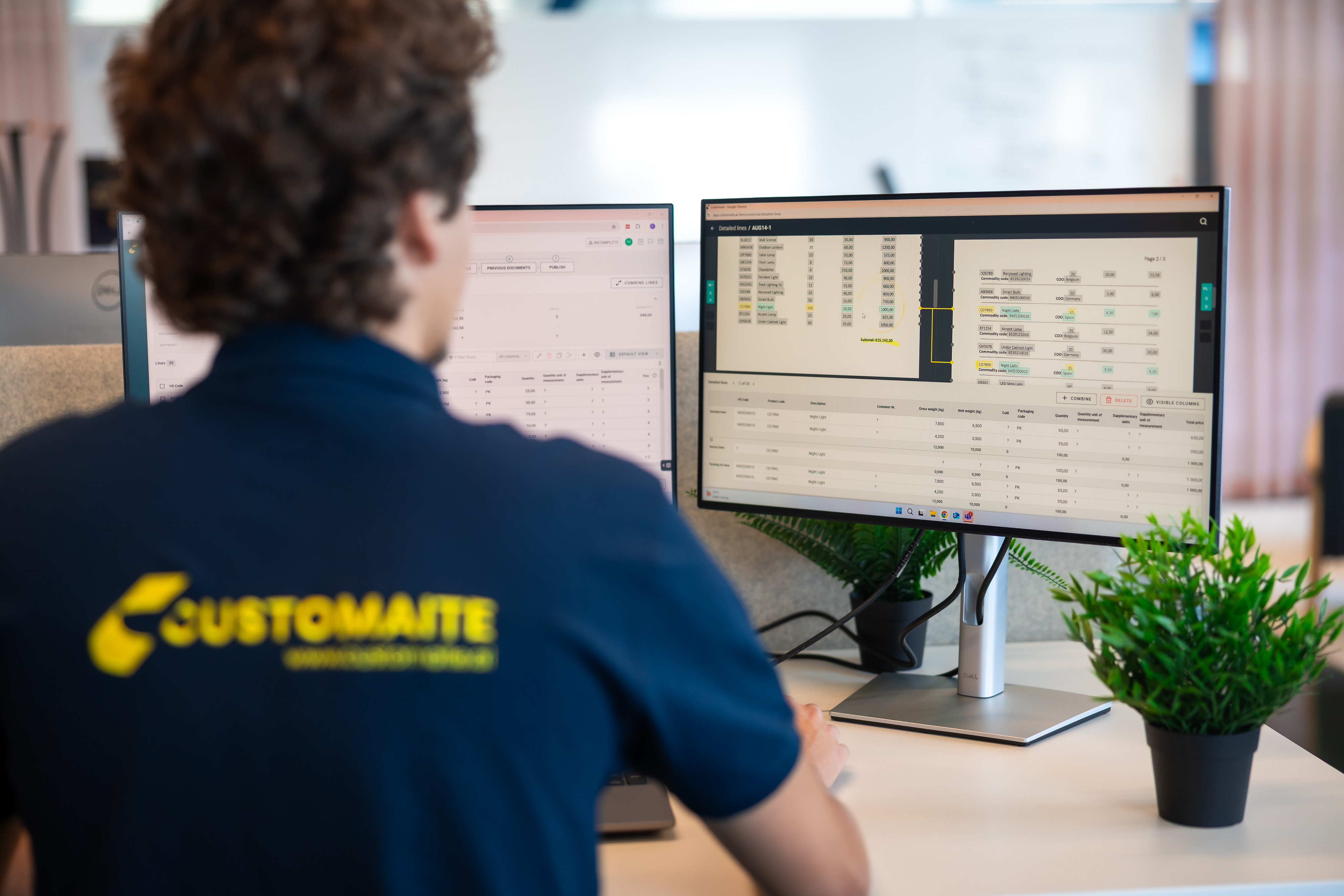
AI expert working on product

AI Myths in Customs Compliance - debunked.

Sep 24, 2026 7 min read
Why declarants spend more time chasing information than declaring goods
Declarant doing manual work

Why declarants spend more time chasing information than declaring goods

Sep 23, 2026 4 min read
What is customs compliance validation?

What is customs compliance validation?

Sep 14, 2026 5 min read